How a walk along the coast of Skye, an old byre and a few pots of plaster and paint came together to create a bespoke piece of artwork.
Living and working on Skye, the landscape is hard to ignore and why would you want to?
The mountains, the sea, the weather, the old stone walls, the beaches and the colours that seem to change every couple of hours following the light.
A lot of my work is influenced by this.
When I'm creating a finish, I'm often thinking about how I can bring some of those qualities into a home. Not necessarily by copying what's outside the window, but by taking inspiration from the colours, textures and materials found in the natural environment.
Recently, I was commissioned by a lovely client in Edinbane, on the west side of Skye, to create a piece of artwork for their home. The brief was to create something that captured the feeling of living on the coast of a sea loch.
I liked the idea straight away.
Rather than sitting down and deciding on a colour from a sample book, I thought lets get out into nature and get the feel for this piece from the landscape it wants to echo.
So off I went for a meander down the coast.
A grey day on the coast
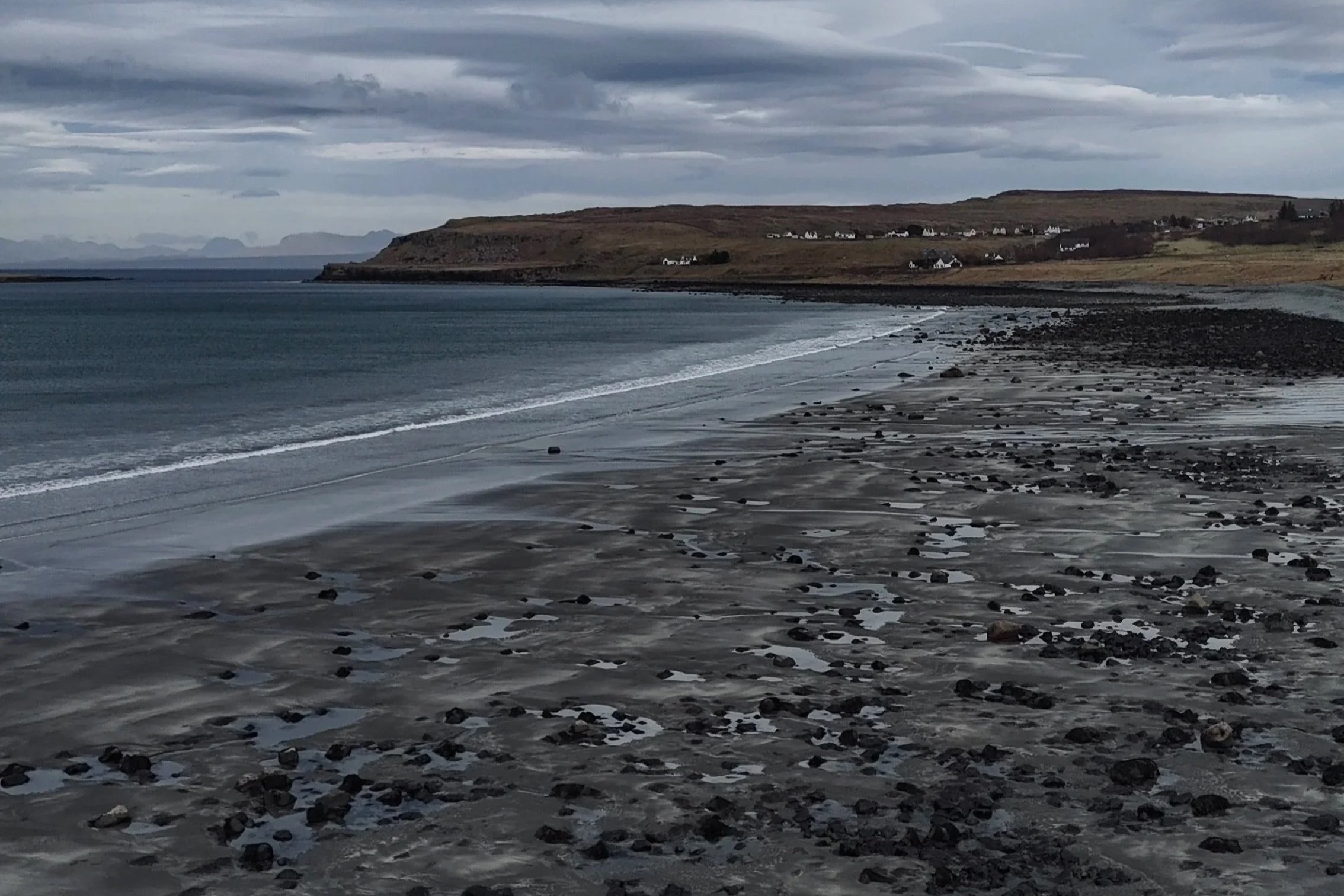
It was a grey, blowy afternoon. Not particularly unusual for Skye, but the perfect time to get a feel for what i was looking for. I headed out along the coast to see what caught my eye. The rocks, the sand, the water, old metal. The marks left behind by the tide.
I was looking at surfaces rather than just looking at the landscape. Asking myself questions to determine what I could bring into the piece. How rough is that rock? Where has it been worn smooth? What colours are actually in it? How does it change when it's wet? Where does the light catch it?
It's amazing how much you notice when you're specifically looking for texture and colour, and trying to capture the spirit of a space.
The wind was blowing across the water and the weather was doing what it does best here. There was that smell of seawater in the air and everything had that slightly darker, muted look you get on a grey Skye day.
Looking at the rocks
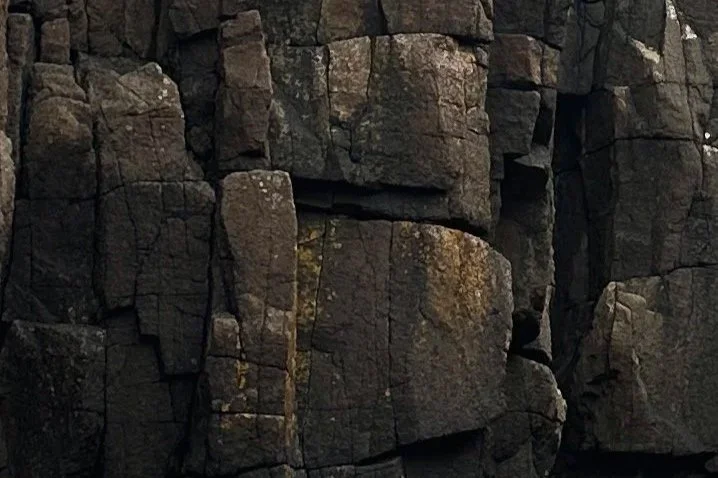
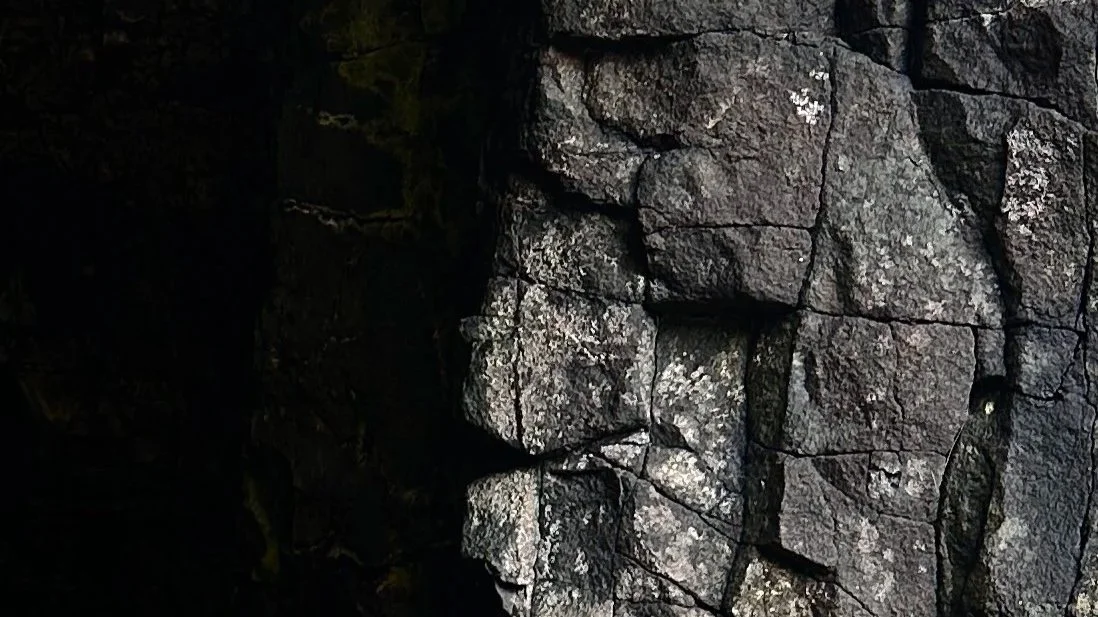
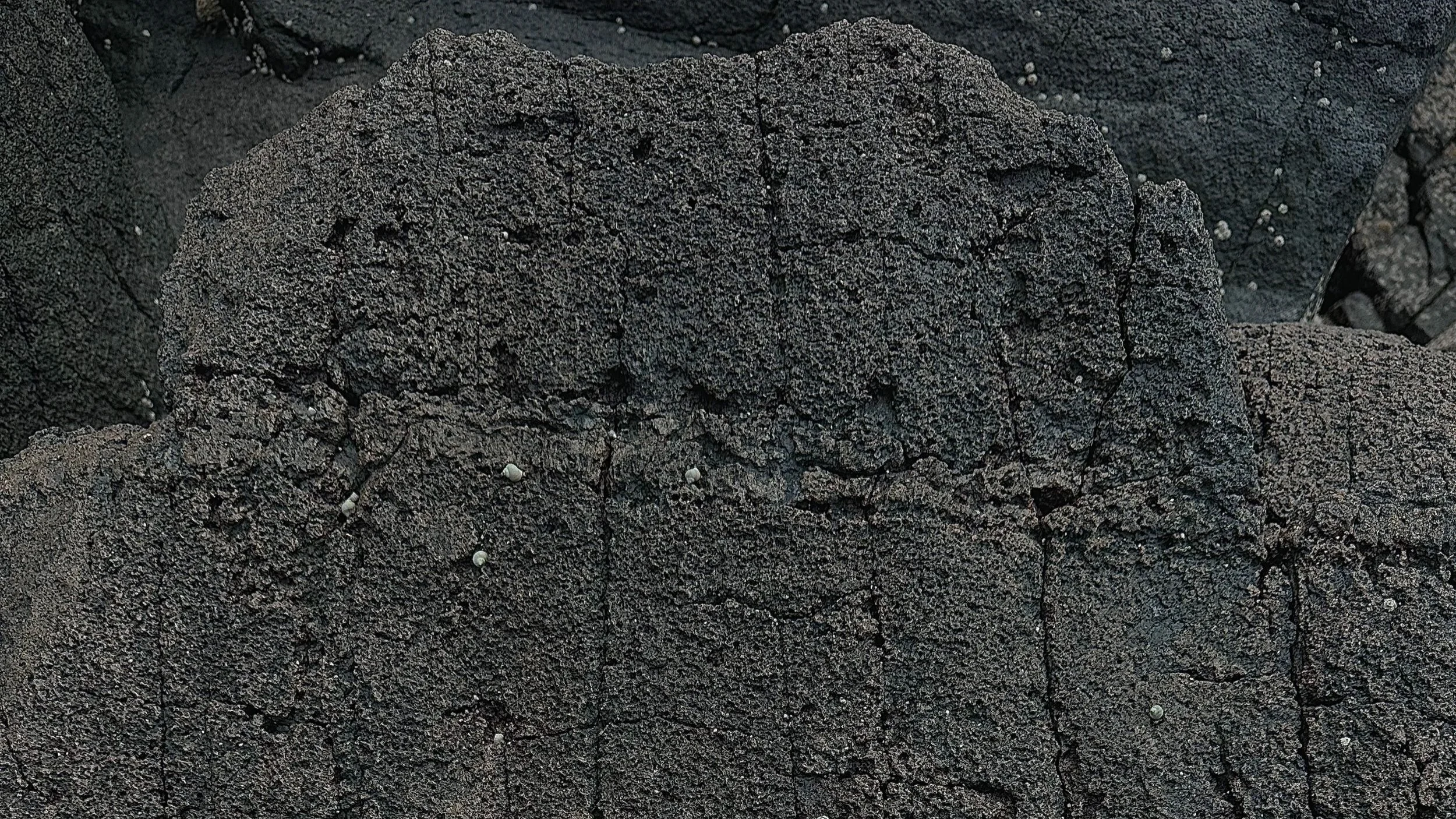
The rocks immediately caught my attention. A lot of them were incredibly dark, almost black in places, particularly where they were wet, but they weren't simply black. There were browns, greys, greens and all sorts of subtle changes in colour depending on the surface and the light.
Some areas were rough and heavily weathered, while others had been worn smooth. There were cracks, layers and sections where the sea and weather had gradually eaten away at the surface.
The same thing applies to the sand. Dark sand mixed with small stones, shells and bits of material brought in by the tide. Then there was the water itself, constantly moving and changing the way everything around it looked.
It's easy to think of colour as being fixed, but it really isn't. A rock can look completely different when it's wet. The sea can look blue, grey, green or almost black depending on the weather. Even the same piece of coastline can look completely different from one hour to the next.
Rock formation: An Corran Beach
Rock Formation: Gold Cave
Rock Formation: Staffin Bay
Weathered wood, rust and age
Further along the coast, I started noticing some of the other surfaces around me. Weathered timber, rust, old metal. Materials that have been outside for years and have simply been left to the weather. This is probably one of my favourite things to look at. There's something about an old, weathered surface that you just can't reproduce by making something look old.
The colour develops over time, rust builds up in layers, wood cracks and changes colour, metal oxidises, the edges get worn down.
I think that's one of the reasons I'm drawn towards creating textured and aged finishes. They have time literally etched on to their surface.
Erosion and imperfection
The longer I walked, the more I noticed erosion. Edges that had been softened by the sea. Sharp edges beside areas that had been completely worn smooth. Small sections of moss growing where they could find a foothold.
This got me thinking about why I enjoy working with decorative finishes in the way that I do. I'm not particularly interested in making every surface perfectly identical. Of course, there are times when a clean, smooth finish is exactly what a room needs. But I also like surfaces that have variation. A bit of movement. Texture. Depth. Something that changes when the light moves across it.
Nature has perfected this. I try to bring some of those qualities into my work.
Back to the old byre
After the walk, I headed back home to my studio. My studio is an old byre. It's dark, old and a little rough around the edges. It's certainly not what you'd picture if you were thinking of a modern artist's studio. And that's probably why I like it. There are old stone walls and timber, and in places nature has started making its way through the building itself. Grass and other greenery grow through parts of the old stonework.
It's not the most conventional place to make artwork, but it’s perfect for what I do. I'm surrounded by old materials, natural textures and all the imperfections that come with age. It's another place where I'm constantly looking at natural surfaces.
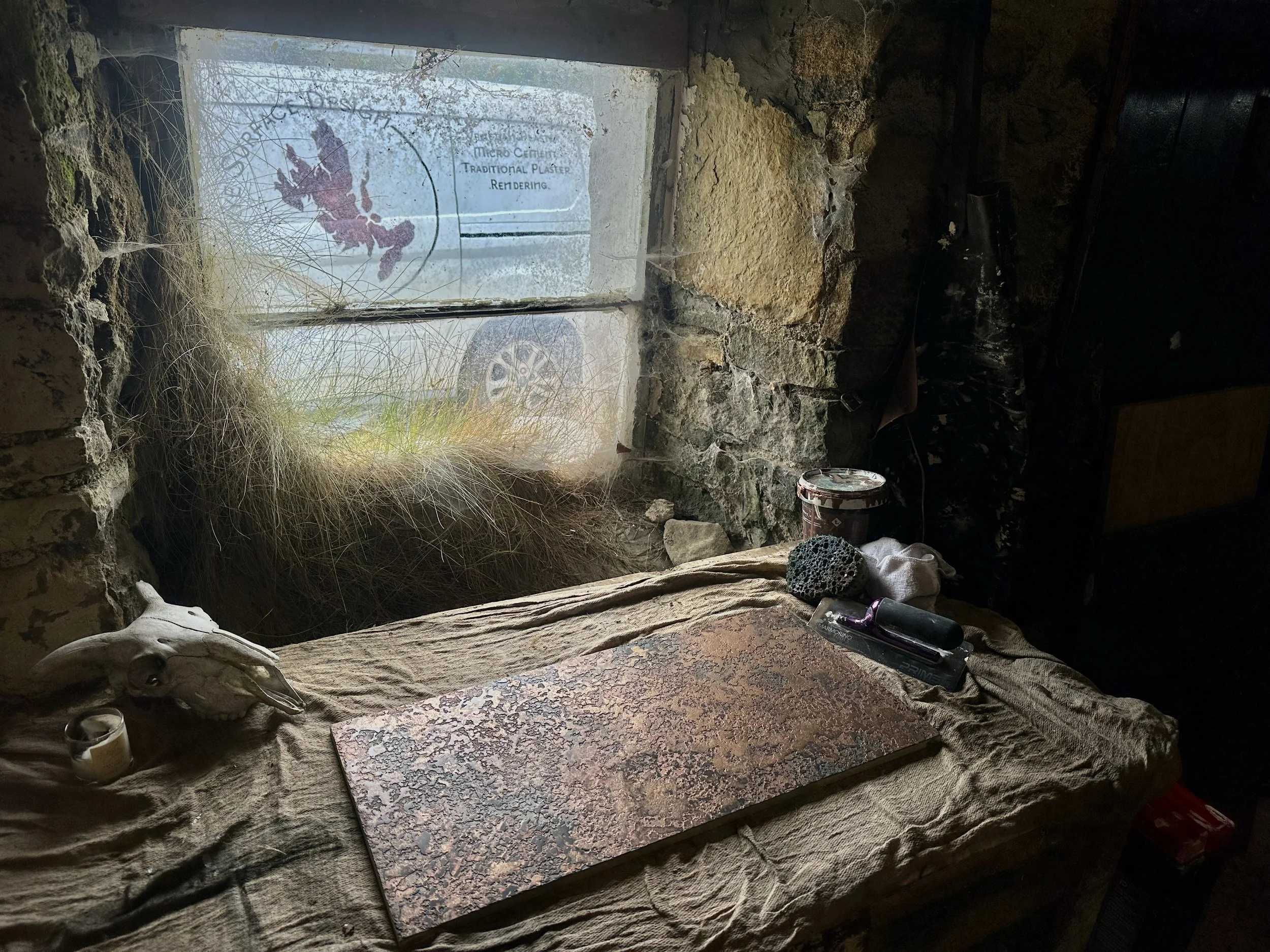
Inside The Old Byre
This is where I started working on the Edinbane piece, which now had a name.. Tidal Patina.
Translating the coastline into a surface
I wanted to create something that felt connected to the coast, but I didn't want to make a literal picture of the sea or a particular rock. Instead, I wanted to capture some of the qualities I'd seen on my walk. The dark rocks, the erosion, the layers, the roughness.
I started with Novacolor Marmorino KS and used it to build up the texture across the piece. Marmorino is a material I really enjoy working with because you can manipulate it and create a huge amount of variation in the surface. For this piece, I wanted it to feel quite geological.
I built up areas of texture and left deeper areas between them, creating something that had plenty going on across the surface. I wasn't trying to make it look like a rock, I wanted it to remind you of one.
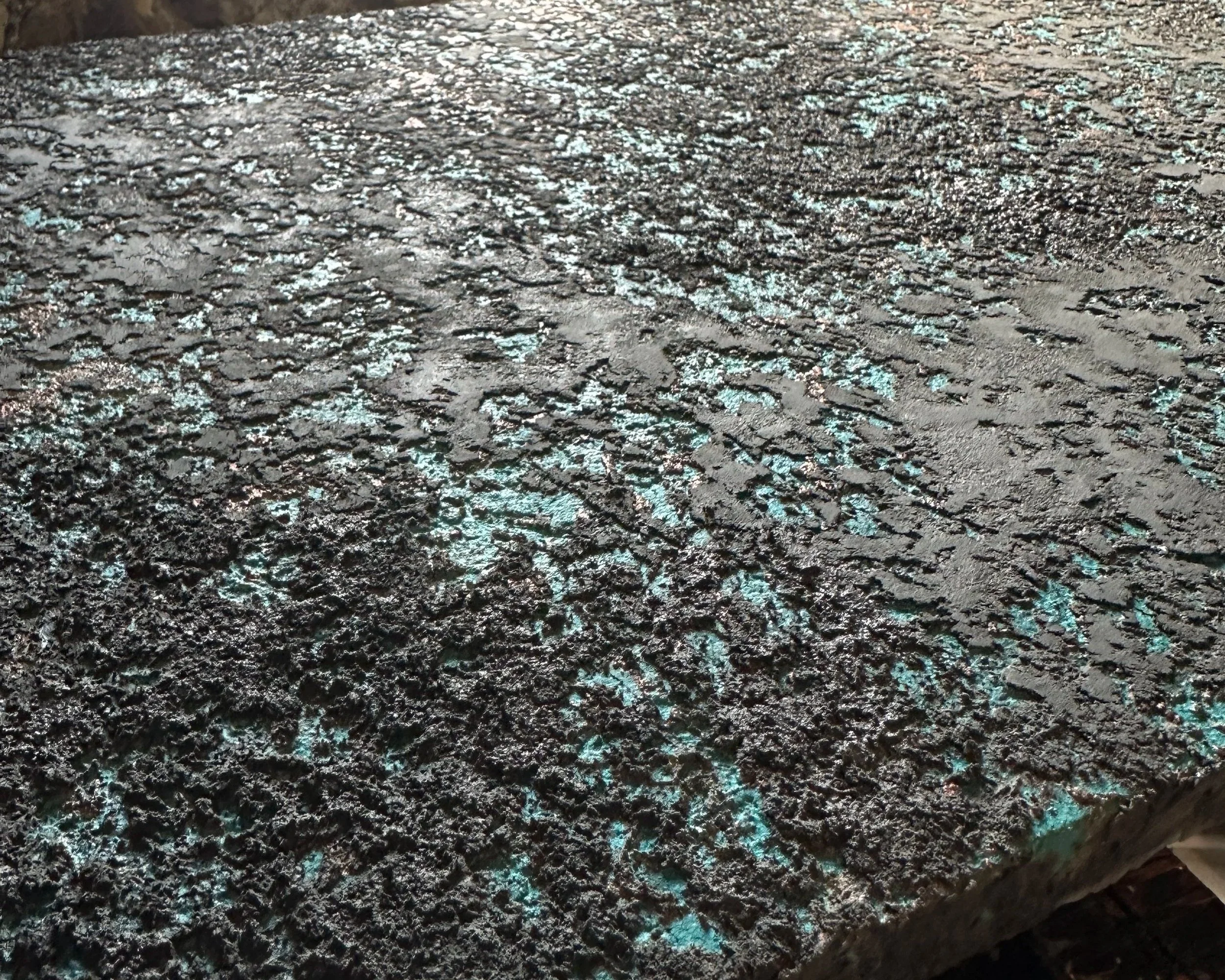
Building up the textured marmorino
.
Adding the copper
Once I had the texture where I wanted it, I started introducing copper paint. This was where another part of the coastal inspiration came into the piece.
I love the way old metal changes when it's exposed to the elements. Copper in particular develops some amazing colours as it oxidises. So rather than simply painting a copper colour onto the surface, I oxidised areas of the copper to create a verdigris effect. I repeated this process layer over layer.
The copper started developing those blue-green tones, sitting against the black areas of the textured Marmorino. It completely changed the surface.
The blue-green reminded me of the colours you find around the coast, moss, the sea itself and weathered materials that have been exposed to the elements.
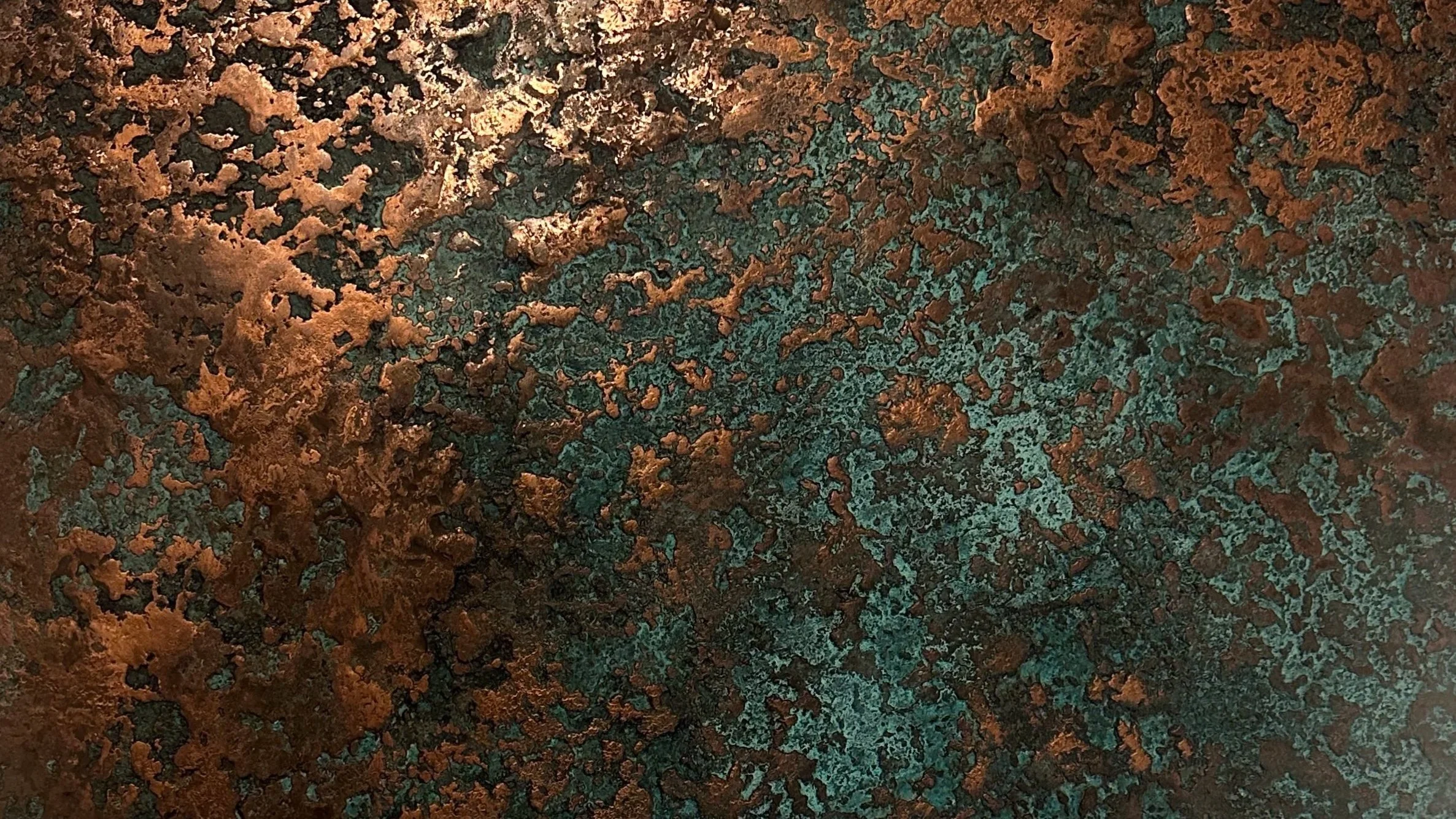
Finished texture of marmorino and copper verdigris
I also like the fact that oxidation isn't completely predictable. You can guide it, but you can’t dictate it.
Giving it some age
The final stage was to bring everything together with a black colour wash. I wanted to knock back some of the brighter areas and give the whole piece a more aged appearance.
The wash settled into the texture and darker recesses, bringing out the depth in the Marmorino. It also helped take away that freshly painted look from the copper and verdigris, I didn't want it to look new. I wanted it to feel as though it had been sitting somewhere on the coast for years. Exposed to wind, rain and salt air. Something that had gradually changed over time. That was the feeling I was chasing.
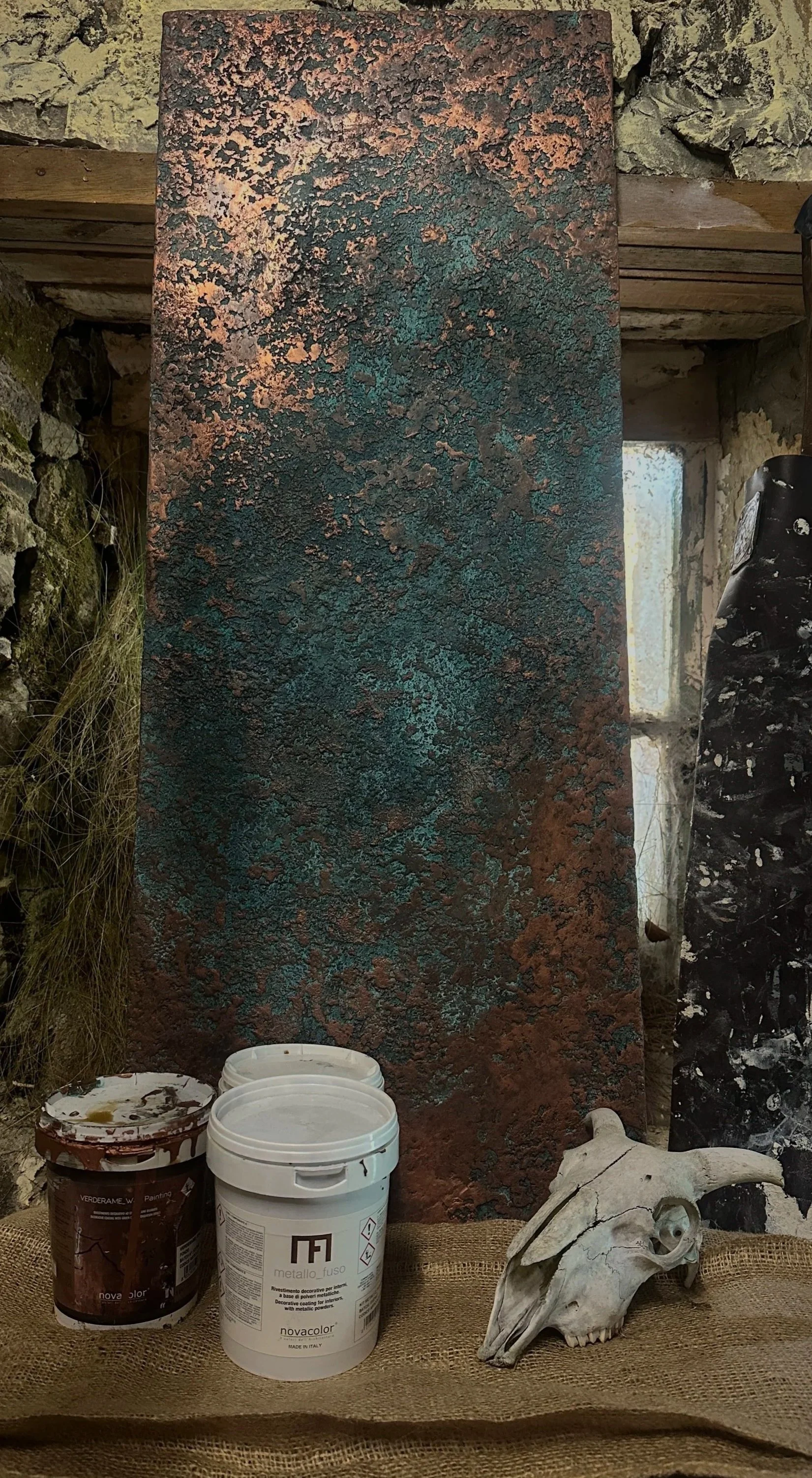
Tidal Patina 1 : Edinbane
From the landscape to the surface
When I look at the finished piece, I can see quite a few of the things I noticed on that walk.
The dark areas remind me of wet rock. The texture comes from looking at the eroded surfaces along the coastline. The copper brings in the warmth of old, weathered metal. The verdigris introduces those blue-green tones. And the black wash gives the whole thing a sense of age.
It's not a copy of anything I saw. It's more of an interpretation. That's how I tend to approach a lot of my work. I'm interested in what a place feels like rather than simply trying to reproduce what it looks like.
Why I'm drawn to lime plaster and natural materials
This is also why I've become so interested in natural and mineral-based materials over the years. I started out with traditional plastering before discovering Venetian plaster, but since then I've worked with all sorts of materials and techniques.
Lime plaster, clay, Venetian plaster, microcement, mineral finishes, metallics and different ways of combining them.
Each material behaves differently. Some are smooth and polished, some are earthy and textured, some react with other materials, some change dramatically depending on how the light hits them.That's what keeps it interesting for me.
I'm still learning, I'm still experimenting.
And I'm still finding new ways of using these materials to create something that isn't simply off the shelf.
Creating interiors that belong to their surroundings
This is particularly important to me when I'm working on interior finishes in Skye, Highlands and Islands at large
There are some amazing homes here, from contemporary new builds to traditional houses and croft properties, and I think the finishes inside them should work with the building and its surroundings rather than against them.
I'm not trying to bring a piece of the landscape indoors literally. It's more subtle than that. It's about using colour, texture and natural materials to create a connection between the inside and outside. A muted colour that works with the hills beyond the window, a textured finish that echoes the stone of an old croft wall, a smooth Venetian plaster that catches the changing light.
Or a more heavily worked lime or mineral finish that brings something earthy into a space. That's what I enjoy about creating bespoke decorative plaster finishes on Skye. Every project gives me an opportunity to think about the space, the building and what's around it.
Inspiration you don't always notice
I don't go out walking around Skye thinking, I'm going to find inspiration for my next project today.
Most of the time, I'm just walking, but I think you absorb things without realising it. The colours you see, the textures, the way the weather changes a surface, the way an old wall has aged, the way the sea moves around the rocks. All of those things become part of how you look at materials.
For this particular commission, it was quite a direct connection. I walked the coastline around the sea loch at Edinbane and the Skye coast looking at rock, sand, water, erosion, weathered materials and oxidisation.
Then I came back to the studio and started working with texture, copper, verdigris and colour. The landscape outside, the old byre around me and the materials I was working with all came together in one piece.
I create bespoke decorative plaster and interior finishes here on Skye, working with clients across the Isle of Skye and the wider Highlands and Islands.
That's probably one of the things I like most about living and working here. You don't have to look very far for inspiration. Sometimes you just need to go for a walk. And sometimes you just need to look a little closer at what's already around you.